
A Guided Development Path for ICF ACC, PCC & MCC Credentials — Supporting Growth Beyond the Syllabus and Core Competencies
Our credentialing mentoring—ACC, PCC, and MCC—is designed as a developmental journey rather than a fixed curriculum.
While every mentoring relationship is tailored to the individual coach and their goals, our work follows a clear developmental logic aligned with the ICF Core Competencies, appropriate to each credentialing level.
Across all levels, our focus is not on performing coaching techniques “correctly”, but on supporting a qualitative shift in how you coach and who you are as a coach.
What differs across ACC, PCC, and MCC is where the primary developmental edge lies, and therefore how mentoring is oriented.
ACC Mentoring – Building Foundations & Consistency
At ACC level, mentoring supports coaches in developing clarity, structure, and reliability in their coaching.
The focus is on:
- understanding and applying the ICF Core Competencies
- developing confidence and consistency
- learning to contract, listen, and respond intentionally
- building trust in the coaching process itself
How We Work
ACC mentoring is more explicit and orienting:
- clarifying what the competencies look and sound like in practice
- supporting conscious skill development
- helping coaches recognize coaching vs. other helping roles
- working with recordings to identify clear competency demonstration
Mentoring at this level often includes:
- naming competencies more directly
- offering clearer guidance and corrective feedback
- supporting exam readiness through understanding expectations
Primary shift: from uncertainty to intentional coaching.
PCC Mentoring – Integration & Fluidity
At PCC level, the focus shifts from learning competencies to integrating them.
Mentoring supports coaches in:
- moving from technique to responsiveness
- developing fluidity and range
- deepening listening beyond content
- refining discernment and timing
- working more consistently with client agenda and awareness
How We Work
PCC mentoring is less instructional and more reflective:
- exploring patterns across recordings rather than isolated skills
- noticing where effort replaces trust
- supporting flexibility and choice in interventions
- refining presence and relational depth
Recordings are used to explore:
- what the coach is doing and why
- how choices impact client awareness
- where the coach could do less and allow more
Primary shift: from applying skills to embodying competence with choice.
MCC Mentoring – Embodiment, Discernment & Presence
At MCC level, technical mastery is assumed.
The mentoring focus moves decisively toward embodiment, discernment, and being.
We explore:
- depth of presence and relational awareness
- following the client’s energy and agenda moment by moment
- discernment: when to intervene — and when not to
- allowing transformation rather than “doing coaching”
- subtle shifts that distinguish PCC from MCC-level work
How We Work
MCC mentoring is highly qualitative and subtle:
- working with micro-moments in recordings
- exploring inner state, not just observable behavior
- noticing where effort, control, or attachment still appear
- trusting silence, emergence, and not-knowing
Mentoring frequently includes a parallel process.
Coaching the Coach – A Parallel Process (Primarily PCC & MCC)
As coaches progress toward MCC, technical skill and inner state become inseparable.
When appropriate, sessions shift from analyzing coaching to coaching the coach:
- working with self-trust, control, and letting go
- addressing internal pressure related to assessment or identity
- supporting emotional regulation and spaciousness
- strengthening capacity to stay present under uncertainty
This parallel process is occasional at PCC level and often central at MCC level, where inner transformation directly impacts coaching quality.
Integration & Readiness (All Levels, Different Depth)
Across all credential levels, the final phase focuses on integration:
- consolidating learning into natural practice
- strengthening confidence and internal reference points
- supporting readiness that comes from embodiment, not performance
What changes by level is depth, not intent:
- ACC: confidence and clarity
- PCC: fluidity and trust
- MCC: stability, ease, and presence
What This Mentoring Is – and Is Not
This mentoring is:
✔ developmental
✔ reflective and experiential
✔ grounded in real coaching practice
It is not:
✖ a checklist-based competency review
✖ a script-driven exam preparation
✖ a “what to say” coaching course
The outcome is a qualitative developmental shift, appropriate to your credentialing level.
ICF Coach Competency Reflection – 5-Minute Coach Wheel Exercise
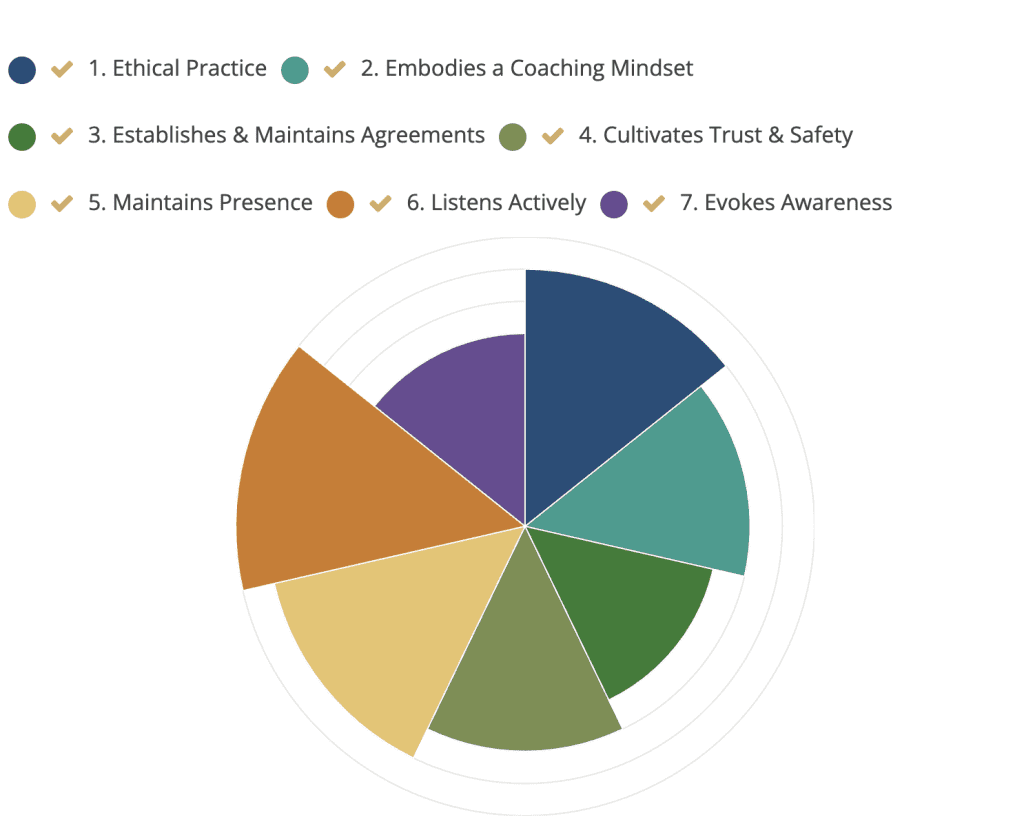
Reflect on your strengths and development areas by exploring your confidence in applying the ICF Core Competencies through this 3-minute Coach Wheel exercise.
Pricing options
For coaches looking to refine their skills, fulfill ICF mentoring or supervision requirements for ACC, PCC, MCC, ACTC, while deepening their reflective professional development.
✔ $200 per hour
✔ 3-hour package – $570 ($190/hour)
✔ 5-hour package – $900 ($180/hour)
✔ 10-hour package – $1,700 ($170/hour)
✔ Led by certified mentors and supervisors with ICF MCC, ACTC, and supervision credentials
✔ Supports ICF credentialing, skill enhancement, and reflective practice
➡ Get started with mentoring & supervision by scheduling a discovery call